Melanoma Detection Using Deep Learning Techniques
🩺 Melanoma Detection using Deep Learning
Overview
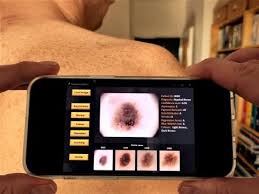
This project applies deep learning techniques to assist in the early detection of melanoma, a type of skin cancer, through automated analysis of dermoscopic images. By leveraging a lightweight convolutional neural network (CNN), the system classifies skin lesions as either benign or malignant, supporting dermatologists in diagnostic decision-making.
The system was trained and evaluated on publicly available medical imaging datasets and deployed with an intuitive web interface for real-time use.
🧰 Key Features
- Classification of skin lesion images into benign or malignant classes.
- Utilizes pre-trained MobileNetV2 architecture for efficient and accurate inference.
- Data augmentation pipeline to enhance model robustness.
- Visualizations of model predictions for interpretability.
- Deployed as an accessible web application for users to upload images and receive immediate predictions.
🔷 Approach & Techniques
- Data Collection: Public dermoscopic image datasets (e.g., ISIC Archive).
- Preprocessing: Resizing, normalization, augmentation (rotation, flipping, zoom).
- Model:
- Base:
MobileNetV2pretrained on ImageNet. - Modified with custom dense layers for binary classification.
- Fine-tuned on melanoma dataset for transfer learning.
- Base:
- Training:
- Loss: Binary Cross-Entropy
- Optimizer: Adam
- Metrics: Accuracy, Precision, Recall, F1-score, ROC-AUC
- Deployment:
- Web app built with Gradio and hosted on Hugging Face Spaces.
🚀 Tech Stack
- Language: Python
- Frameworks/Libraries:
- TensorFlow / Keras
- OpenCV
- scikit-learn
- Gradio
- Matplotlib, Seaborn (for visualization)
- Deployment:
- Hugging Face Spaces
📊 Impact
This project demonstrates how transfer learning with lightweight CNN architectures can provide fast, accurate predictions for critical healthcare tasks. The deployment as a web app ensures accessibility, making it a practical aid for early melanoma detection, which is crucial for improving patient outcomes.